
In This Article:
SEPSIS HAS continued to challenge the medical profession throughout history. It is a serious life-threatening medical condition triggered by the body’s response to infection and dates back some 5,000 years ago. The oldest written mention of sepsis occurred in 3,000 B.C. in a surgery treatise that referred to “48 cases of traumatic wounds, fractures and dislocations in different parts of the body,” as well as fever. Sepsis was also cited by physician and philosopher Hippocrates circa 400 B.C. as “dangerous biological decay believed to occur in the colon and release various substances which caused ‘auto-intoxication.’”1
In 129-199 A.D., Roman pharmacologist Claudius Galenus, known as “Galen,” “theorized about sepsis, wound healing and pus which lasted for 1,500 years.” The Romans believed sepsis was caused by “invisible creatures that gave off fumes,” rather than considering person-to-person contact of infectious disease.1
It took until the late 19th and early 20th centuries for sepsis to be better understood. The first consensus as to how sepsis should be defined was developed at a conference in the early 1900s, but it was modified in 2001 to distinguish between an infection, sepsis, severe sepsis and septic shock. Modern guidelines for severe sepsis and septic shock developed in 2003 were modified in 2012. Those included some of the same principles outlined in 1964, including cardiac resuscitation, identifying the pathogen to start targeted treatment and support for the respiratory system. Today, there are newer management techniques.2
Sepsis is one of the most frequent causes of death worldwide. Unfortunately, the collection of reliable data is challenging. However, published data in 2020 show there were 48.9 million cases and 11 million sepsis-related deaths worldwide, representing 20 percent of all global deaths, almost half (20 million) of which occurred in children under 5 years of age. Sepsis occurs in an estimated 15 out of every 1,000 hospitalized patients as a complication of receiving healthcare. It can affect any individual worldwide, but significant regional disparities in incidence and mortality exist with the highest rates in lower-middle-income countries.3 In the U.S., at least 1.7 million adults develop sepsis each year, and at least 350,000 adults who develop sepsis die during hospitalization or are discharged to hospice.
While most sepsis cases start before a patient goes to the hospital, one in three who dies in a hospital had sepsis during their hospital stay. In addition, most people who develop sepsis have at least one existing medical condition such as chronic lung disease or a weakened immune system. And, nearly a quarter to a third of people with sepsis had a healthcare visit in the week before they were hospitalized.4 On average, the hospital-wide cost of sepsis is estimated to be more than $32,000 per patient in high-income countries.3
Unfortunately, many myths surround sepsis that can delay diagnosis and treatment both at the patient and clinical level. And, with sepsis causing more deaths than prostate cancer, breast cancer and AIDS combined,5 it is more important than ever to separate myth from fact.
Separating Myth from Fact
Myth: Sepsis is just a bad infection.
Fact: According to the Sepsis Alliance, sepsis isn’t actually an infection, but rather the body’s overreaction to an infection, causing the body to injure its own tissues and organs.6 Although the words “sepsis” and “infection” are often used interchangeably, the word “sepsis” always indicates the presence of an infection, but the word “infection” does not indicate sepsis. Sepsis is actually the most severe form of infection with some degree of organ dysfunction present, with the patient presenting as hypotensive, oliguric and/or obtunded.7
Myth: Sepsis is always obvious.
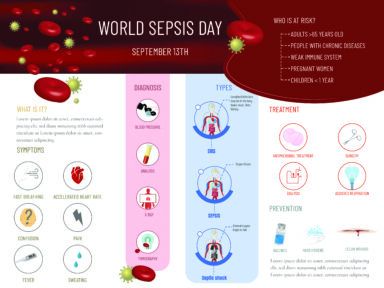
Fact: Sepsis is not always obvious because its symptoms are very similar to other illnesses. As such, sepsis can often be overlooked. And symptoms can occur anywhere on a person’s body. Common symptoms of sepsis include:8
- Reduced energy or weakness
- Low blood pressure
- Fever or hypothermia (extremely low body temperature)
- Shortness of breath or hyperventilation (rapid breathing)
- Extreme discomfort or pain
- Urinary issues such as reduced or increased urge to urinate
- Chills or shaking
- Sweaty skin
- Confusion and agitation
The Sepsis Alliance suggests using the word TIME to remember the most common sepsis symptoms:9
T: Is the person’s temperature higher or lower than normal?
I: Did the person have any signs of an infection, and does he or she now?
M: Is there any change in the person’s mental status such as confusion or excessive sleepiness?
E: Is the person experiencing any extreme pain or illness, even a feeling of “I feel I might die”?
Myth: Sepsis is only developed by coming into contact with bacteria.
Fact: Bacterial infections do cause most cases of sepsis, but they are not the only cause. Sepsis can also be caused by viral or fungal infections. According to the University of Chicago, the most common sites of infection include:10
- Lungs (i.e., pneumonia)
- Skin (i.e., burns, wounds, cellulitis)
- Bloodstream
- Brain or spinal cord
- Gastrointestinal system (i.e., appendicitis, peritonitis, gall bladder or liver infections)
- Digestive system
- Kidneys, bladder or other parts of the urinary system
- Catheter sites
Myth: Only old people or people with preexisting conditions get sepsis.
Fact: Sepsis can affect anyone, even those in good health. People who are at high risk of sepsis include those who:11
- Are over age 65
- Are pregnant
- Have certain medical conditions such as diabetes, obesity, cancer and kidney disease
- Have a weakened immune system
- Are in the hospital for other medical reasons
- Have severe injuries such as large burns or wounds
- Have catheters, IVs or breathing tubes
- Newborns and infants
Myth: Sepsis only happens in hospitals.
Fact: While sepsis often develops in hospitalized patients, it can begin anywhere. In fact, 87 percent of cases start in the community rather than the hospital, according to the Centers for Disease Control and Prevention.6
Community-acquired sepsis is typically diagnosed within the first 48 to 72 hours of hospitalization. According to a report from The Medical Algorithms Company titled “The Many Faces of Sepsis (5): Progression from a Community Acquired Infection,” while there are a wide range of community infections associated with sepsis, some common causes include:12
- Pneumonia
- Urinary tract infection
- Cholecystitis
- Soft tissue infection
- Intra-abdominal infections such as bacterial enteritis or diverticulitis
Myth: Persons being treated with antibiotics can’t get sepsis.
Fact: While antibiotics treat many bacterial infections, sepsis can still develop if an infection worsens or when the cause is viral or fungal.
According to the Sepsis Alliance, viral infections are usually treated by managing the symptoms using over-the-counter pain relievers to ease pain and reduce fever, rest for fatigue, etc., until the virus is gone. Some medications may speed healing if they are taken early enough after exposure to the virus, including medications for influenza and shingles (herpes zoster).13
Also according to the Sepsis Alliance, fungal infections are treated with anti-fungal medications, such as creams, ointments, suppositories or pills, specific to the particular fungus that caused the infection. However, antibiotics are not used for fungal infections because they are not effective.14
Myth: Sepsis is contagious.
Fact: Sepsis can’t be spread to other people. However, the viral or fungal infections that lead to sepsis are contagious and can spread from person to person. As mentioned previously, bacterial infections cause most cases of sepsis, but sepsis can also be a result of other infections, including fungal and viral infections.
Myth: There is no way to prevent or lessen the effects of sepsis.
Fact: The only way to prevent sepsis is to prevent infections. Vaccinations are one way to significantly reduce the risk of infections caused by certain illnesses. According to the End Sepsis website, the most important vaccines for reducing the risk of getting sepsis include pneumococcal vaccines since pneumonia is a leading cause of sepsis; influenza vaccines since the flu can lead to complications such as pneumonia, which can progress to sepsis; meningococcal vaccines; the measles, mumps and rubella vaccine; and other vaccines, such as those for Haemophilus influenzae type b (Hib), varicella (chickenpox) and COVID-19 vaccines, which also contribute to reducing the risk of infections that could lead to sepsis.15
In addition, a new promising medicine, Tyzavan (vancomycin injection), is an FDA-approved, ready-to-infuse, room-temperature stable formulation of vancomycin used to treat serious bacterial infections. It was launched by Hikma Pharmaceuticals in late 2025, and is indicated for septicemia, endocarditis and other serious infections in patients 1 month and older.16
Myth: Sepsis cannot be overcome.
Fact: Sepsis is curable if it’s treated on time. There are three stages of sepsis:8
- Sepsis: when an infection enters the bloodstream and causes inflammation
- Severe sepsis: when sepsis begins affecting organ function
- Septic shock: when sepsis causes a drop in blood pressure and complications such as organ dysfunction, heart failure or respiratory failure, stroke or even death
Myth: If sepsis is suspected, treatment should begin only after testing.
Fact: Because sepsis is a serious and life-threatening illness, it’s critical that people are treated in a timely manner, and that means getting treatment as soon as sepsis is suspected rather than waiting for a diagnosis of sepsis. Sepsis is known as the “silent killer” for good reason, because it’s often hard to detect.
According to the Sepsis Alliance, treatment may include broad-spectrum intravenous antibiotics, which are the first-line medications that work against several of the more common bacteria; IV fluids to help keep blood pressure from dropping dangerously low, causing shock; and oxygen, either by mechanical ventilator, mask or nasal cannula, to ensure the body has enough oxygen in its system.17 Some patients may require an operation or procedure to control the infection.
Dispelling the Myths Now
Sepsis is a life-threatening illness and continues to be a challenge for the healthcare profession. Many people are simply unaware of it and its cause, and others are confused by its many circulating misconceptions. As such, it’s imperative to educate the public about the facts surrounding this illness that often results in death.
In 2024, the Sepsis Alliance conducted its annual awareness survey and found that 69 percent of U.S. adults are aware of the term “sepsis,” up significantly from 63 percent in 2023 and in contrast to its first survey in 2007 when only 16 percent were aware of the term “sepsis.” Since its founding in 2007, the Sepsis Alliance has “implemented awareness-raising campaigns, prioritizing Spanish-language materials and outreach to underserved communities in the last several years.” However, according to the alliance, the survey revealed striking misconceptions about infections and sepsis that showed most people (77 percent) do not believe or do not know that influenza can progress to sepsis, or haven’t heard the term “sepsis.” In addition, 82 percent do not believe or do not know that vaccines can prevent someone from getting sepsis.
While the alliance’s website explains that this progress is encouraging, it adds that “there is a need for additional education and action.” According to the site, a national sepsis action plan could save thousands of lives from sepsis each year, citing one example from the Centers for Disease Control and Prevention’s 2012-2018 TIPS education campaign featuring “real people from many different backgrounds living with serious long-term health effects from smoking and secondhand smoke exposure” that is estimated to have helped one million people successfully quit smoking. A National Sepsis Action Plan, supported by government agencies, media and multiple partners, it says, would provide accessible education and resources in an effort to increase knowledge and awareness of sepsis.
More information on how healthcare providers can help educate and spread awareness about the seriousness of sepsis can be found on the alliance’s website at www.sepsis.org/news/sepsis-awareness-reaches-69-while-misconceptions-about-sepsis-and-infections-exist.18